Six short steps, from the curve itself to what the numbers can and cannot show.
Illustrative: y² = x³ − 3x + 1, one curve of the kind we study. The two dots sit at (x, y) and (x, −y) for the same x.
What an elliptic curve is
An elliptic curve is the set of points (x, y) that satisfy an equation like y² = x³ + ax + b, with a and b fixed. On the plane it usually looks like an oval plus an open branch that runs off the page.
The curves in this work have whole-number a and b. The points we care about are the ones whose coordinates are fractions of whole numbers.
Exact points on curve 389a1, y² + y = x³ + x² − 2x, at equal scale on both axes. The small dots are combinations of P = (−1, 1) and Q = (0, 0) under the group law, computed in your browser and checked against PARI.
Rank
If you draw a line through two points on the curve, it meets the curve again at a third point. Flip that point over and you get another point on the curve. Starting from a few points and repeating this produces more.
Some curves have only finitely many fractional points. Others have infinitely many. The rank is how many independent starting points you need. For 389a1 the rank is 2: the points (−1, 1) and (0, 0) generate the rest.
11a1, rank 0: L(1) = 0.2538
37a1, rank 1: slope at 1 = 0.3060
389a1, rank 2: touches zero at 1
The L-function L(E, s) for real s, computed with PARI’s lfun.
A conjecture from the 1960s
The Birch and Swinnerton-Dyer conjecture says the rank can be read off from a single computable number: how many times the curve’s L-function vanishes at s = 1. That L-function is built by counting the curve’s points modulo every prime.
In the graph, 11a1 does not vanish at 1, 37a1 vanishes once, and 389a1 vanishes twice. The ranks are 0, 1, and 2. The conjecture is one of the seven Millennium Prize Problems. There is a $1 million prize for a proof, and it has been open since the 1960s.
A diagram of the method, not a map of the 8,942-curve audit. Left: a sketch of checking one curve after another. Right, illustrative: the first levels of a 3-adic tree, the digit tree that p-adic arithmetic is built on.
What we do
We check the formula on one curve at a time. For each curve we compute the L-function side and the arithmetic side and compare them at the precision we used.
There is also a p-adic version of the formula, built on a single prime p. In that arithmetic, two numbers are close when their difference is divisible by a high power of p.
8,942curves checked against the formula, 0 mismatches
168 / 168p-adic checks agreed on 40 curves, plus 40 / 40 in a second batch
217,024p-adic regulators certified non-zero, across 10,807 curves
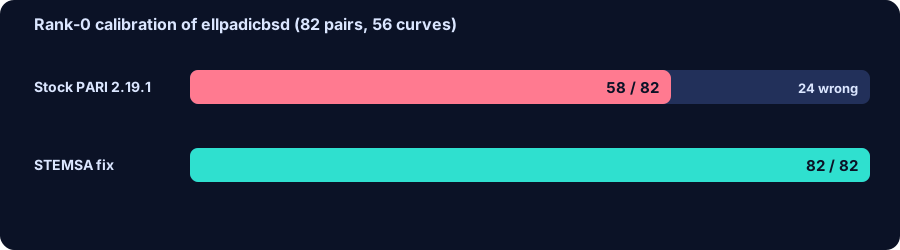
82 / 82rank-0 checks agree with our fixes; stock PARI agrees on 58. One example from a larger overhaul
Figures from the research write-up below. The amber bar is stock PARI, 58 of 82.
The numbers so far
The audit covered 8,942 curves and found no mismatches. The p-adic check agreed in every case we completed, and 217,024 p-adic regulators were certified non-zero.
That 58-to-82 figure is one example from a larger overhaul of PARI/GP’s p-adic BSD routines: with the fixes, the rank-0 checks went from 58 agreements under stock PARI to 82 out of 82.
A proof would have to cover every elliptic curve, so a finite audit is not a proof. We are publishing the tables and the scripts, and we plan to release PARI 2.0 under the GNU GPL.
These are consistency checks on a finite list of curves. They are evidence for the conjecture and they prove nothing.
Why it matters
None of this proves the conjecture. A proof would have to cover every curve. We can still put the tables and scripts in public, along with PARI 2.0, which we plan to release so other researchers can run the same checks.
What we found
The formula held on every curve we checked. The cases that matter most are ranks 2 and 3, where theory gives no guarantee. A mismatch there would have needed an explanation, and we did not find one.
Along the way we overhauled the p-adic BSD routines in PARI/GP, after finding bugs that produced wrong p-adic answers on some curves. The 58-to-82 rank-0 case above is one example, not the whole of that work. That is why these computations run on PARI 2.0, our modified build. It is not affiliated with or endorsed by the PARI Group.
A consistency check on a finite list of curves is evidence for the conjecture. It is not a proof.
The technical write-up
Formulas, tables, methods, and sources, as of 22 November 2026.
For an elliptic curve \(E/\mathbb{Q}\) of analytic rank \(r\), the strong form of the Birch–Swinnerton-Dyer conjecture predicts the leading Taylor coefficient of the L-function at \(s=1\):
Here \(\Omega_E\) is the real period, \(\mathrm{Reg}_E\) the Néron–Tate regulator, \(c_p\) the Tamagawa numbers, and \(\mathrm{Sha}\) the Tate–Shafarevich group. Solving for the right-hand side gives an analytic order of Sha that must be a perfect square integer. For a prime \(p\) of good ordinary reduction there is a p-adic analogue (Mazur–Tate–Teitelbaum), which replaces \(L\) by the p-adic L-function \(L_p(E,s)\) and \(\mathrm{Reg}_E\) by the cyclotomic p-adic regulator \(\mathrm{Reg}_p\):
where \(\alpha\) is the unit root of \(x^2-a_px+p\). Checking that the p-adic side reproduces the complex value of Sha is a strong consistency test. It is exact, and not just up to p-adic units, only in ranks 0 and 1 where interpolation or Gross–Zagier–Kolyvagin theory applies. In rank 2 and above, “nothing exact is known”, which is why numerical evidence is interesting.
Scope of this page
These are independent re-computations and modest extensions of existing numerical work. Where earlier literature covers the same ground we name it; we do not claim any new theorem.
Strong BSD on six curves
For each curve we computed the analytic rank and leading coefficient with ellanalyticrank, the factor \(\Omega\prod c_p/\#\mathrm{tors}^2\) with ellbsd, and the regulator from Cremona’s stored generators. The ratio is the analytic order of Sha.
Curve
Rank
\(L^{(r)}(E,1)/r!\)
\(\mathrm{Reg}\)
tors
\(\prod c_p\)
Sha (analytic)
11a1
0
0.25384186085591
1
5
5
1
37a1
1
0.30599977383405
0.05111140823997
1
2
1
43a1
1
0.34352397461848
0.06281650708749
1
1
1
53a1
1
0.43586382417786
0.09298148463865
1
1
1
389a1
2
0.75931650028843
0.15246017794314
1
2
1
5077a1
3
1.73184990011930
0.41714355875838
1
2
1
On all six, the ratio equals 1 to at least 50 digits of residual. That is a numerical consistency check of the leading-term formula, not a proof; for ranks 2 and 3 the analytic rank is itself a numerical decision.
A counterexample hunt: 8,942 curves, 0 red flags
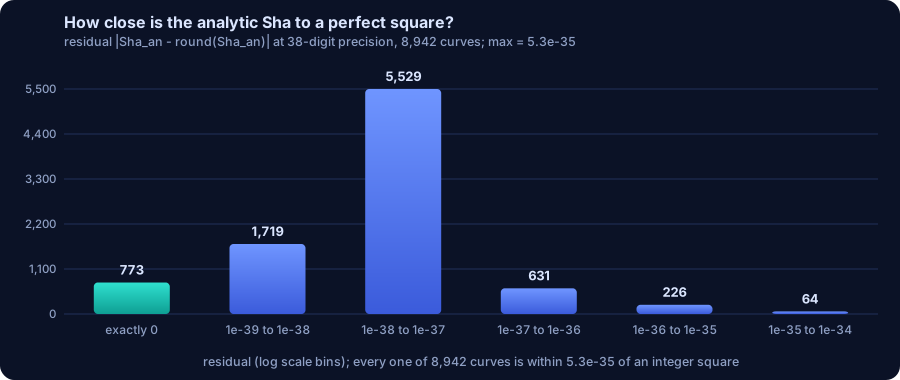
We audited every optimal curve of rank ≥ 3 in Cremona’s tables with conductor below 500,000 (8,899 of rank 3 and one of rank 4, 234446a1) and the 42 curves of rank 2 with analytic Sha > 1 (all with analytic Sha = 4). Each curve was checked at 38 digits for:
root number agrees with the parity of the analytic rank;
analytic rank and \(L^{(r)}(E,1)\) via ellanalyticrank;
Cremona’s generators re-saturated (primes up to 100) and the regulator recomputed;
2-descent (ellrank) bounds consistent with the rank;
analytic Sha is a perfect square, within \(10^{-8}\).
0 / 8,942curves flagged
8,900rank-3+ curves with Shaan = 1 (max residual 5.3e-35)
42rank-2 curves with Shaan = 4 (max residual 1.8e-37), matching Cremona’s published values
~165 swall time on 7 parallel processes
Distance of the analytic Sha from the nearest perfect-square integer, all 8,942 audited curves.
Negative control. Dropping one generator of 5077a1 raises both the Sha and rank-mismatch flags, and they survive recomputation at 100 digits, so the flag logic does detect a “missed point”. Replacing a generator by its double is silently repaired by saturation, as expected.
Cross-check. Three curves were compared with the LMFDB (rank, regulator to 10 digits, Sha: all match). The remaining lookups were blocked by a bot check, and we did not work around it.
Caveats
For rank ≥ 2, finiteness of Sha is not known, so a square value is evidence, not proof. Only optimal curves below conductor 500,000 are covered; LMFDB lists many more rank-3, -4 and -5 curves at larger conductor.
p-adic BSD in ranks 0 to 3
For each (curve, ordinary prime) pair we compute the p-adic L-function from overconvergent modular symbols (msfromell, mspadicinit, mspadicmoments, mspadicL), find the order of vanishing, and compare the resulting prediction for Sha with the independent complex value. “Agree” means they match to the full p-adic precision computed.
Rank
Set
Pairs agreeing
p-adic digits
Notes
0
10 control curves
31 / 31
7–10
Theorem (interpolation): sanity check of the pipeline
1
10 control curves
38 / 38
5–7
Gross–Zagier/Kolyvagin range
2
40 smallest-conductor curves (389a1…1431a1)
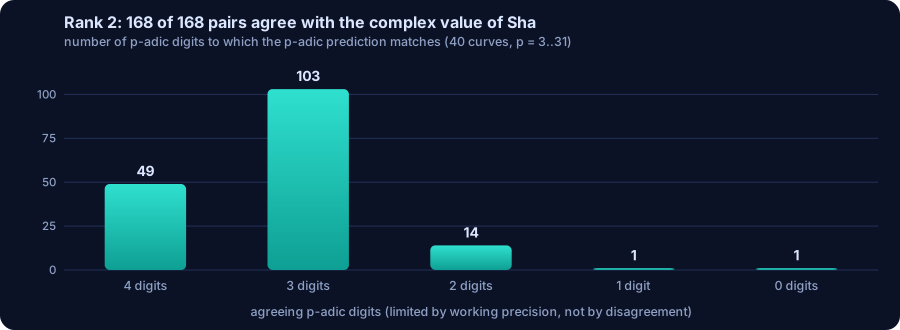
168 / 168
1–4 (mostly 3–4)
2 further pairs hit memory limits; 389a1 checked at ten primes 3…31
2
42 further curves, 2nd batch (desktop run)
40 / 40
1–4
25 stack overflows at the 6 GB cap, 10 supersingular, 9 bad reduction
3
9 rank-3 curves (5077a1, 11197a1, …)
18 / 18
2–3
Order of vanishing 3 every time; 2 pairs still running, 1 memory failure
Zero disagreements in any rank among the pairs that completed.
The memory wall.mspadicinit memory grows like \(O\bigl(N^2 (n+k)^2\,p\bigr)\) in the conductor \(N\) and prime \(p\), so larger pairs run out of PARI stack even with tens of GB. That wall is the main motivation for the GPU work.
Precision loss. In rank 3 the third-derivative coefficient has valuation 3 and \(\mathrm{Reg}_p\) valuation 1–3, so only about \(n-3\) to \(n-5\) p-adic digits survive.
An anomalous case. At 1141a1, \(p=5\), working precision \(n=6\) reported a spurious p-adic rank 4; at \(n=9\) and \(n=11\) the rank is 2 and the quotient is \(1+O(5^4)\), a precision artefact of an anomalous regulator.
p-adic digits of agreement achieved in each rank; higher rank loses digits to precision.
Prior work
This kind of check, including rank 3 (5077a1), was done by Mazur–Stein–Tate (2006) and at scale mod p by Stein–Wuthrich (Math. Comp. 82, 2013). Our contribution is an independent re-run, at higher p-adic precision on a modest set, with a reproducible pipeline.
A table of 217,024 p-adic regulators
The p-adic regulator \(\mathrm{Reg}_p\) could in principle vanish. The p-adic height pairing is conjecturally non-degenerate, and p-adic BSD needs \(\mathrm{Reg}_p\neq 0\). We computed it for every good ordinary prime \(5\le p<100\) and every optimal curve with at least two generators and conductor \(\le 30{,}000\) (9,642 curves of rank 2), plus rank-3 curves with \(30{,}000<N\le 150{,}000\): 10,807 curves in all (9,642 of rank 2 and 1,165 of rank 3).
v ≤ 6largest \(v_p(\mathrm{Reg}_p)\) seen, e.g. 5718a1 at \(p=5\); normalized valuation at most 4
~8 minon five processes, under 100 MB each
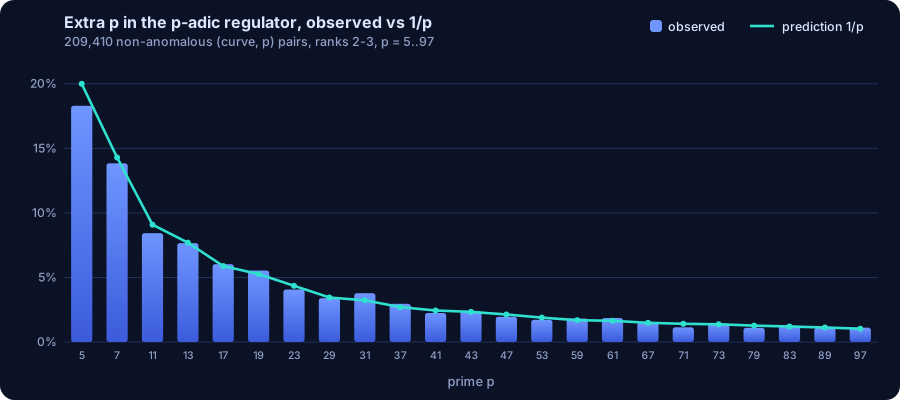
Write \(v_n=v_p(\mathrm{Reg}_p)-r\) for the normalized valuation. Among the 209,410 non-anomalous pairs, \(v_n=0\) in 200,778, \(v_n\ge1\) in 7,620, and \(v_n<0\) in 1,012. All 1,012 negative cases have \(p\mid\prod c_p\) (PARI computes heights via multiples, which introduces a \(p^{-2}\) per such factor); we checked every one. The share with \(v_n\ge 1\) follows the heuristic \(1/p\) closely:
Observed share of non-anomalous pairs with extra \(p\) in the normalized regulator, versus \(1/p\). Overall 3.62% vs 3.67% predicted (rank 2) and 3.76% vs 3.90% (rank 3).
Prior work
Stein–Wuthrich (2013, Thm 1.1) cover 1,534,422 pairs of rank ≥ 2 and conductor \(\le 30{,}000\) with \(5\le p<1000\). Our rank-2 part is a reproduction of a subset; the rank-3 slice with \(30{,}000<N\le150{,}000\), \(p<100\) is a routine extension and not a new result.
Where the valuations come from
Rearranging p-adic BSD gives an exact bookkeeping identity for valuations:
The Euler factor term vanishes unless \(p\) is anomalous (\(a_p\equiv1 \bmod p\)). We joined torsion, Tamagawa and Sha data onto 44,792 pairs and tested the identity.
On the 127 pairs where every term is known (31 of rank 0, 38 of rank 1, 40 of rank 2, 18 of rank 3) the residual is exactly zero.
In that set, every extra \(p\) in the normalized regulator is matched by an extra \(p\) in the leading p-adic L-derivative: \(v_n = v_{\mathrm{lead}}-r\) in all 10 non-anomalous cases with \(v_n>0\).
Anomalous primes (7,614 pairs) have \(v_p(\alpha-1)=1\) in every covered example, so the Euler term is exactly \(-2\); \(v_n\) is \(-2\) for 7,040 of them.
Rank 2 vs rank 3, and small vs large conductor, look alike: 3.62% (n = 185,846) vs 3.76% (n = 23,564) of non-anomalous pairs have \(v_n\ge1\), stable across conductor buckets from below 2,000 up to 150,000.
Open gap
We did not recompute \(L_p^{(r)}\) for the 1,770 table pairs that show leftover extra \(p\); the 127 complete pairs suggest the extra sits in the L-value too. Also, \(p\mid\mathrm{Sha}\) never occurred in our sample, so that column is untested.
Nothing here contradicts p-adic BSD.
A normalization bug in PARI’s ellpadicbsd, and our fix
A software finding, not a mathematical one. The case below is one example from a larger overhaul of the p-adic BSD routines in PARI 2.0; the figures are for this fix only.
When the twist argument \(D\) is omitted, ellpadicbsd in stock PARI 2.17.2 and 2.19.1 silently replaces \(E\) by a minimal-conductor quadratic twist. For some curves with additive reduction at 2 (conductors divisible by 16: 912, 944, 960, 1008, 1040, 1088…) that returns a Sha-side value off by a factor of 2 or 4. It already shows at rank 0, where \((1-1/\alpha)^{-2}L_p(\chi_0)=L(E,1)/\omega\) is a theorem and ellpadicL itself satisfies it.
Calibration. On 82 rank-0 (curve, p) pairs over 56 curves of conductor 900–1100 divisible by 8, stock PARI 2.19.1 gave the wrong answer on 24 of 82; with the fix, 82 of 82 agree with the complex value (and our independent normalization was right on 82/82 throughout).
Fix. Do not auto-twist when \(D\) is omitted; a user-supplied \(D\) behaves as before. It is a small change (about a dozen lines) in src/basemath/ellpadic.c, included in PARI 2.0.
Re-checked on 22 November 2026 by running both binaries on the same machine (CPU path). The 389a1 outputs for ellpadicL and ellpadicbsd were identical between stock and our build. Root cause in the Tamagawa/torsion correction step is not fully identified; we have not yet reported it upstream.
A small murmuration
One representative per isogeny class of conductor at most 5,000: 7,914 curves of rank 0, 8,811 of rank 1 and 589 of rank ≥ 2. For the first 1,999 primes we averaged the coefficient \(a_p\) by rank.
Average \(a_p\) by rank for \(p\le 4000\). Rank 0 and rank 1 oscillate with opposite phase, the pattern found by He–Lee–Oliver–Pozdnyakov and later studied by Zubrilina, Sawin–Sutherland and others. A small reproduction, not a new theorem.
Rank-2 lattices: an exploratory look
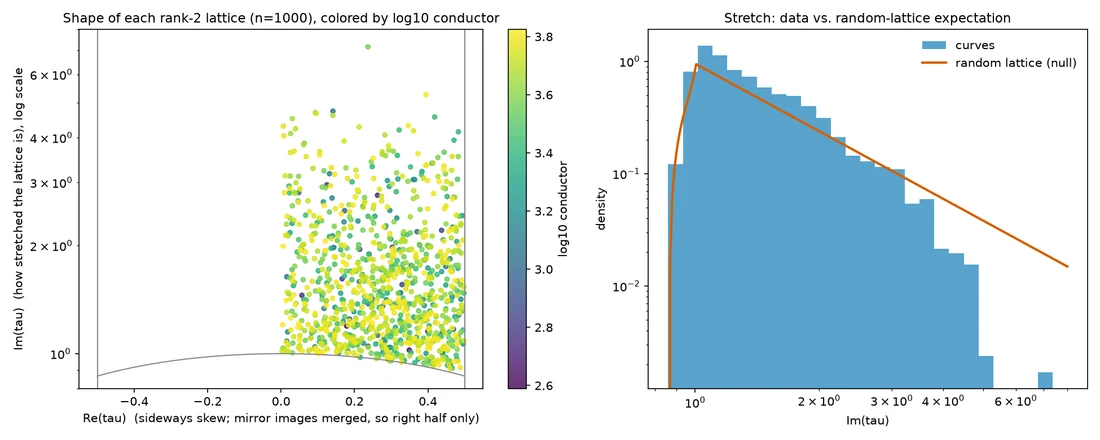
For the first 1,000 curves with exactly two Mordell–Weil generators (conductors 389–6,672) we asked whether the shape of the height lattice \(\tau\) in the modular fundamental domain looks like a random lattice.
BSD passes on 1000 / 1000 (analytic Sha is exactly 1 on all; all root numbers +1, so those two features cannot be tested).
The shapes are not random-lattice-like: median \(\mathrm{Im}\,\tau\) is 1.455 against 1.908 for a random lattice (KS \(p\approx10^{-54}\)), partly because generators have a minimum height.
Weak correlations remain after adjusting for that: with torsion order (\(\rho\approx-0.17\)) and with the regulator (\(\rho\approx-0.21\)); none with conductor.
Heegner sanity check on the first 15 curves: \(L(E/K,s)\) vanishes to order 3 for an imaginary quadratic field \(K\) satisfying the Heegner hypothesis, so by Gross–Zagier the Heegner point is torsion, as expected at rank 2.
Exploratory analysis; the tests were pre-registered informally but not corrected beyond a Bonferroni threshold.
The rank-2 gap, and where compute helps
For analytic rank \(\le1\), Gross–Zagier and Kolyvagin build a Heegner point whose height gives \(L'(E,1)\) and use it to prove rank = analytic rank and finiteness of Sha. At rank 2 the Heegner point is torsion and no theorem over \(\mathbb{Q}\) expresses \(L''(E,1)\) as the height of any cycle. Function-field analogues exist (Yun–Zhang), and p-adic surrogates (Darmon–Rotger generalised Kato classes, exact p-adic BSD) are partly proven. A literature map is in our working notes.
Numerical directions where an outsider with compute can contribute, and where we are pushing with the GPU build:
A non-CM table of the exact rank-2 p-adic BSD quotient at \(p^6\) and beyond, including supersingular primes and the 42 rank-2 curves with Sha = 4 (these need more than 6 GB in PARI).
Closing the one open case in Stein–Wuthrich, 389a at \(p=16{,}231\), with overconvergent modular symbols.
Tables of anomalous p-adic regulators against the \(1/p\) heuristic.
Leading-coefficient numerics for the Mazur–Tate refined conjecture in rank 2.
The build used for this work
These computations were run on PARI 2.0, our modified PARI/GP with an overhaul of the p-adic BSD routines (the ellpadicbsd auto-twist case is one example) and an OpenCL kernel, to be published under the GPL.